Emergency electrician in Grand Rapids — what to do first, and when it will not wait until morning
Yes — a 24-hour electrician answers in Grand Rapids right now: call (616) 636-1250 at any hour, any day, and the line rolls to a live dispatcher rather than voicemail. The rest of this page is how to tell a real emergency from a morning job, and what to do in the ten minutes before anyone arrives.
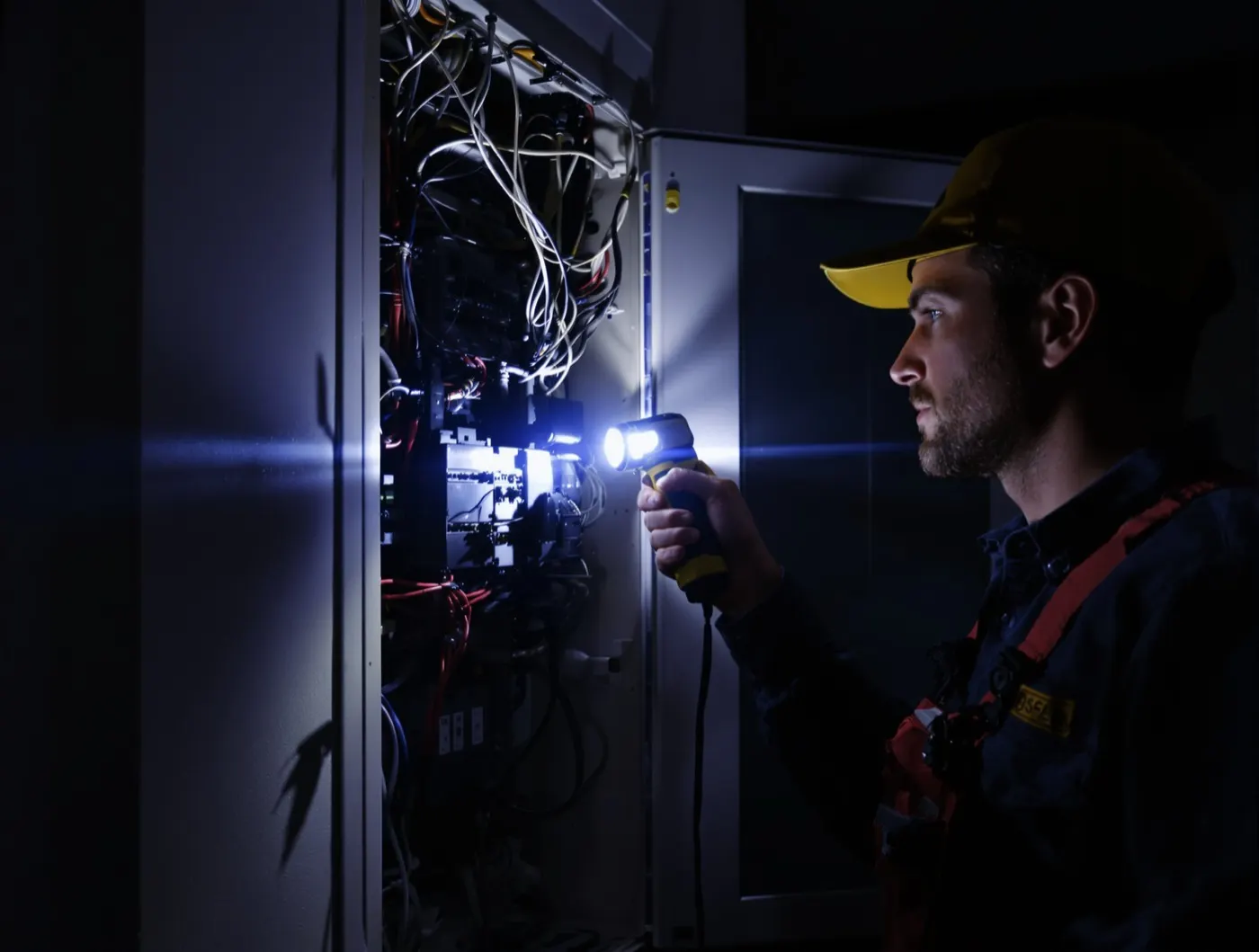
Yes, an electrician is open now
Call (616) 636-1250 at any hour. The line rolls to a live dispatcher — not a voicemail box — and the call goes to the next local Grand Rapids electrician on rotation. A 24-hour electrician call runs the same way at 2 AM as it does at noon: describe what you are seeing, get the call-out charge confirmed before anyone rolls, and nothing further is billed without your say-so. The rotation covers the whole metro, not just the city — Wyoming, Kentwood, Walker and the surrounding suburbs make the same call to the same number. If the reason you are calling is on the list below, do not wait until morning.
Stop and call straight away
These do not wait. If any of them is happening, turn the circuit off at the panel if you can do it safely, and call:
- A burning or fishy smell near an outlet, switch or the panel. Hot plastic has a distinct smell and it means something is overheating right now.
- Scorch marks or discoloration around an outlet or on the panel door.
- Sparks or arcing — more than the small blue flash some appliances make when unplugged under load.
- A buzzing, crackling or humming panel, or a breaker that is hot to touch.
- Water into a panel, outlets or fixtures — a burst pipe, a roof leak, a flooded basement.
- A shock from an appliance, faucet or switch plate, however small.
- A downed line on your property. Stay well away and call the utility and 911, not an electrician.
Usually urgent, but not dangerous
These need attention soon and are not worth a middle-of-the-night call-out rate unless they are making life impossible:
- A breaker that trips, resets, and holds.
- Half the house dark with no smell or heat — often a lost leg of the service, worth reporting to the utility first.
- One dead outlet or a dead circuit.
- A flickering light in a single fixture — usually the bulb, the dimmer or the fixture itself, which makes it lighting repair work to book for daylight, not a call tonight.
Can this wait until morning — or does it need someone now?
Most people calling late at night want to know the same thing: is this dangerous enough to pay after-hours rates, or can it wait until morning? Read across from what you are seeing:
| Symptom | Call tonight? | The reason |
|---|---|---|
| Burning or fishy smell near an outlet, switch or panel | Yes — call now | Overheating inside a wall or box can ignite insulation. It does not improve by waiting. |
| Sparks or arcing at an outlet or panel | Yes — call now | An active fault. The risk does not decrease on its own. |
| Water into a panel, outlets or fixtures | Yes — call now | Water and live conductors must be isolated before the house is safe. |
| A shock from a switch, faucet or appliance | Yes — call now | A grounding or bonding fault that can repeat and cause injury. |
| Panel warm to touch, buzzing or humming | Yes — call now | A panel running hot is carrying more than something is rated for. |
| Lights suddenly bright in some rooms, dim in others | Yes — call now | The classic sign of a lost or loose neutral. Half the house can run over-voltage, burning out electronics and overheating devices until the fault is isolated. |
| Breaker trips, resets and holds | Tomorrow is fine | The breaker is doing its job. Note what was on the circuit and book a same-day call. |
| One dead outlet or switch | Tomorrow is fine | Usually a failed device or a tripped GFCI upstream — not an active fault. |
| Half the house dark, no smell or heat | Check the utility first | Wide area outages are the utility's job. Check their outage map before anyone is dispatched. |
| GFCI that trips and will not reset | Same day, not midnight | Worth a look, but rarely dangerous enough to pay after-hours rates. |
| Flickering in one light or fixture | Tomorrow is fine | Usually a failing bulb, a loose fixture connection, or a dimmer that cannot handle the load. |
What to do before anyone arrives
- Kill the circuit, not the appliance. Switch the breaker off rather than just unplugging.
- Do not reset a breaker that keeps tripping. It is doing its job. Repeated resets on a fault are how a nuisance becomes a fire.
- Never run water near it, and never use water on an electrical fire.
- If the panel itself is smoking or you smell smoke in a wall, get everyone out and call 911. An electrician is the call after the fire department, not before.
- Leave the main off if you turned it off. Restoring power to an unknown fault is the risk you were avoiding.
Is it the utility or your house? A 60-second check
The single fastest way to save yourself an after-hours call-out is to work out whether the fault is on your side of the meter or the utility's. It takes under a minute and it changes who to call first.
- Step outside and look up the street. If the neighbors' porch lights and the street lights are also out, the outage is upstream and belongs to the utility, not to an electrician. If the neighbors' lights are on and yours are not, the fault is on your side of the meter — an electrician's problem.
- Check your utility's outage map before you dial. Consumers Energy is the electric utility for most of the Grand Rapids metro, and its outage map lists wide-area outages with an estimated restore time. An electrician cannot restore utility power, and a call-out to confirm the utility is off costs the same as one to fix a real fault.
- Look at your main breaker. Open the panel door and find the large double breaker at the top. If it is in the middle position — neither fully on nor fully off — it has tripped. Do not flip it back on if you smell heat, see scorch marks or hear a buzz from the panel: that is when to call. If it looks and smells normal, switch it firmly off and then on. A main that trips and holds is worth a same-day appointment; one that trips again immediately is a call tonight.
- Test outlets on different circuits. Kitchen, bath, garage and outdoor outlets are usually on GFCI protection and may be dead because a GFCI upstream has tripped — press "reset" on any GFCI-marked outlet in those areas before assuming a broader fault. If only one room or one wall is out, it is almost certainly a branch-circuit issue rather than a service problem — worth booking tomorrow, not a midnight visit.
- Watch the meter as someone toggles a switch inside. If the meter display is dark, the service is off at the pole. If the meter is live and the panel is on but nothing works inside, the fault is between the two and belongs at the top of the priority list.
Is it the appliance or the house? A 90-second test
A surprising share of 24-hour electrician calls turn out to be one broken appliance rather than a fault in the house wiring. The test takes under two minutes and can save an after-hours dispatch fee outright:
- Unplug the appliance, then plug something else into the same outlet. A lamp, a phone charger, a table fan — anything you know works. If the outlet feeds the other item cleanly, the wiring is fine and the appliance is the fault.
- Try the appliance on a different circuit. Move it to a room on the far side of the house, on a different breaker. If it trips a breaker or a GFCI on a second circuit too, the appliance is drawing more than it should — the house is not the problem. Unplug it and leave it unplugged until it is repaired or replaced.
- Feel the plug and the cord where it meets the appliance. A cord that is hot at the plug end, a plug with pitted or discolored blades, or a burning smell that follows the appliance from outlet to outlet is a failing device. The outlet it was in when you first noticed the trouble is worth a pro look — but the appliance is out of service tonight either way.
- Look at what changed today. A brand-new appliance that trips a breaker the first time it runs is the appliance, not the house. An older space heater, window air conditioner or portable fan that has started tripping breakers this week has almost always failed internally rather than exposed a wiring fault.
If the fault does turn out to be at a single receptacle — a warm face plate, a loose plug, a scorched slot — the permanent fix is outlet and switch repair booked for daylight, not a call tonight.
What "open now" actually gets you at 2AM
A midnight call is a different job from a daytime service call, and worth knowing the shape of before you dial:
- A dispatch fee, told to you up front. After-hours work carries a call-out charge whether or not a repair happens that night. Ask for the number when you call, not when the van pulls in.
- Make-safe first, permanent fix later. The 2AM visit isolates the fault and gets the rest of the house back on. The full repair — a new circuit, a section of wiring or rewiring work, a panel upgrade — is usually scheduled for daylight, when parts, permits and the utility disconnect are easier to line up.
- What an electrician who is open now cannot do. A licensed electrician cannot restore utility power. A downed line, a wide area outage, or a damaged service drop from the pole is the utility's job — an emergency electrician answering the phone tonight will tell you as much, then hang up so you can call the utility.
- Have this ready before you dial. Your address, what you are smelling, seeing or hearing, whether the main breaker is on or off, whether the panel is accessible, and whether anyone in the house is on medical equipment that needs power.
How soon an electrician open now is actually at the door
"Open now" answers the phone right now — it does not always park in the driveway right now. A midnight call in Grand Rapids typically reaches the house within the hour when the on-call electrician is close and the roads are dry, and it can run longer when any of the below is true. Ask the dispatcher for a realistic arrival window when they route the call, so a decision about whether to wait by the panel with a flashlight or leave a light on for someone can be made honestly:
- Where the on-call electrician starts from. After hours, the nearest tech is usually at home rather than at a shop — a call routed across the metro from Wyoming or Walker to the east side of Grand Rapids adds real drive time, even at 2 AM when there is no traffic to fight.
- Weather. A lake-effect snow band, an ice storm or a summer downpour slows every visit and stacks the queue: the same weather that dropped your power dropped a lot of neighbors' power at the same time.
- Life-safety calls jump the queue. A house full of smoke, a shock injury, a hospital or care-home call reroutes the next available truck. A dead circuit or a tripping breaker waits by design when a hazard call comes in behind it — an honest dispatcher tells you so.
- Whether the main is already off and the fault is isolated. A house already made safe by killing the main becomes a scheduled early-morning visit for many faults, not a middle-of-the-night one — say so on the call and the dispatch can be booked calmly for first light.
- Address access. A locked gate, a long private drive, a rural address the GPS gets wrong, or a downtown building with after-hours entry rules all add minutes at the arrival end. Say what to expect at the door when you call.
Not every "electrician open now" is the same phone call
Search for an electrician open now in Grand Rapids at 3 AM and every result promises the same thing. What actually happens once you dial is one of three things — worth knowing which before deciding to wait by the panel:
| What the number reaches | What you hear | What that means for arrival |
|---|---|---|
| A live dispatcher on rotation | A person picks up, takes the address and the symptom, and names the on-call electrician who will call back or roll directly. | The tightest arrival window. The dispatcher can see who is closest and whether anyone else is already out on a call, and can give a realistic window rather than a guess. |
| An answering service that pages the on-call tech | A neutral operator takes your name, number, address and a one-line description, then pages the electrician on rotation. Expect a callback in about ten to twenty minutes. | An extra step, but the technician is real and the callback happens. The delay is the message being relayed, not somebody being woken up cold. |
| A voicemail that promises a return call | A recording tells you a call will be returned "as soon as possible" with no time frame, or a general business mailbox with no after-hours option. | Not an emergency line. If the fault will not wait, hang up and try the next number rather than sit on a phone that may not ring back until office hours. |
Ten-second test on any electrician who is open now: if the first live human asks for your address and what you are seeing, the line is a real emergency line. If the first live human asks you to hold while the on-call tech is paged, wait — that is normal. If nobody picks up, or the number rolls to a general mailbox, treat the search result as a daytime business with the words "24/7" on the page rather than a real emergency line, and dial the next one.
Answering the phone and rolling a truck are two different 24/7 promises
"Open now" can mean the office is answering around the clock, or an electrician is actually rolling a truck around the clock — and it is worth knowing which before you commit to waiting. Some Grand Rapids shops pick up at 3 AM to take your name and book you first thing in the morning; others pick up at 3 AM and dispatch tonight, but only for hazard calls — a burning smell, sparks, water into a panel — and everything else waits for daylight; a smaller number roll the same night for any electrical problem, at the after-hours rate. Knowing which shape you are on the phone with changes the decision in front of you: if the fault is on the "tomorrow is fine" list above and the shop's real offer is morning-first, the honest move is to book the morning slot and go back to bed rather than sit up expecting a truck that was never coming tonight. Two direct questions cut through the ambiguity: is an electrician being dispatched now, and if yes, what is the after-hours dispatch fee? A hedge on either question is the same answer as no — call the next number on the list rather than stay on hold.
What the dispatcher needs — and what each piece does for you
The dispatcher routes the call to the nearest available electrician and needs specific information to do it quickly. Here is what gets asked and why each answer matters:
| What to have ready | Why the dispatcher needs it |
|---|---|
| Full address and ZIP code | Routes to the nearest electrician and confirms which permit office applies to any follow-up work. |
| What you are seeing, smelling or hearing | Sets the urgency level and determines what diagnostic tools the tech brings — a burning smell sends a different kit than a dead circuit. |
| Whether the main breaker is on or off | Tells the electrician whether the house is live or dark before they step through the door. |
| Whether the panel is in a locked space | A panel behind a locked utility room or garage door can stall the first step of the visit — the dispatcher can tell you what to unlock before anyone arrives. |
| Whether anyone in the house needs powered medical equipment | Changes the urgency tier and can move the dispatch ahead in the queue. |
| Whether you are a tenant or the property owner | Affects who can authorize repairs and who the invoice goes to — the dispatcher needs to know before the truck rolls. |
Choosing a 24-hour electrician you have not met before
Almost every 24-hour electrician call in Grand Rapids is the first time the homeowner has hired that particular pro — panic and midnight are not when anyone shops around calmly. A short checklist keeps the after-hours visit honest, and none of it is rude to ask at 2 AM:
- The dispatch fee is a number, told to you over the phone. Any electrician who will not name one before rolling is not the right call. When the technician arrives, ask for the charges in writing before work starts — a text to your phone counts.
- License and insurance, even at 2 AM. Ask for the license number when you call, and a current certificate of insurance when the tech arrives; a licensed pro carries both without any push-back. Michigan licenses electricians through LARA, and a license can be verified publicly at michigan.gov/lara.
- Written scope before power is restored. The make-safe work is small; write down what was isolated, what was replaced tonight, and what is scheduled for daylight. A verbal "we swapped the breaker" turns into a disagreement a week later.
- No cash-only ultimatum. A card reader that appears at midnight for an "urgent" price you were never told about earlier is the pattern to walk away from — a real 24-hour electrician bills the same way at midnight as at noon.
- Permits are not skipped because of the hour. If tonight is only the make-safe half of the job, ask when the permitted repair is scheduled and who pulls the permit — the electrician doing the work should, and the permit number belongs on your paperwork.
What a 24-hour call costs in Grand Rapids
After-hours work carries real costs beyond the daytime rate. Knowing the shape of those costs before you call lets you make a clear decision rather than discovering them when the van pulls in:
| Factor | What it means for the bill |
|---|---|
| Time of the call | Overnight calls carry a higher dispatch fee than daytime service calls. Ask for the current after-hours rate when you first call — a straightforward electrician states it before anyone is dispatched. |
| Weekend or holiday | Weekend and holiday dispatch usually adds to the base call-out charge. Confirm before anyone rolls. |
| Make-safe only vs. same-night repair | Some faults are fixed completely in one visit. Others — those needing replacement parts, a permit inspection, or a utility disconnect — are made safe overnight and repaired the next business day. The dispatch fee applies in either case. |
| Permit-required work | Work requiring a City of Grand Rapids permit cannot be put into service until a city inspector approves it. That inspection does not happen at midnight, which is why the 2 AM visit ends the emergency and the final repair is scheduled for daylight. |
Symptom, likely cause, and what the electrician does on arrival
The first hour of the call runs the same shape almost every time. Read across from what you are seeing to what the electrician does when they get there:
| Symptom | Common cause | What the electrician does on arrival |
|---|---|---|
| Burning or fishy smell at the panel | Overheating breaker, or a loose landing on the bus | Kills the main from outside, opens the panel, tests each termination for heat, isolates the fault before restoring anything. |
| Sparks or arcing at an outlet | Loose splice, damaged conductor, or a failed device | De-energizes the circuit at the panel, opens the device, remakes the connection or swaps the outlet, tests before energizing. |
| Half the house dark, no smell or heat | Lost service leg on the utility side, or a main-breaker trip | Measures voltage at the meter and main first. If the loss is upstream, the utility is the call — not the electrician. |
| Water into a panel or outlets | Roof leak, burst pipe, or a flooded basement | Kills the main from outside, isolates every wet circuit, dries and inspects each device. Nothing gets repowered until it can be seen dry. |
| Panel warm to touch, buzzing or humming | A bad breaker, a loose bus connection, or a failed aluminum termination | Powers down at the main, removes the cover, tests for heat and correct torque, replaces the faulty component, and re-tests before closing up. |
| A shock from a switch, faucet or appliance | Missing or broken ground, or a bonding fault | Tests the ground and bond on the affected branch, finds the missing or broken path, and corrects it before the circuit is put back into service. |
| Lights bright in some rooms, dim in others | Lost or loose neutral at the panel or in the service | Measures voltage across both legs at the main, gets sensitive loads off until it is stable, and brings in the utility if the fault sits in the service drop rather than the house. |
| A dedicated circuit smoking behind an EV charger | Undersized conductor, loose lug, or an EV circuit installed without the load check the job needs | Kills the charger circuit at the panel, opens the charger and the panel end, and does not restore power until the run has been re-sized or the terminations remade. |
What an emergency visit actually does
The first visit is about making it safe, not finishing the job. That usually means isolating the fault, proving what is and is not live, and getting the rest of the house back on. The permanent repair — a new circuit, a panel, a section of wiring — is scheduled once everyone can see what is wrong in daylight.
If the fault turned out to be one symptom of an older system — cloth-covered cable in the basement, a panel with no spare slots, three-prong outlets that were never grounded — a whole-house electrical inspection is the calm way to find out what else is waiting, priced as one visit instead of a string of surprises. And any fault that involved smoke, scorching or overheating is also the night you find out whether the alarms in the house work: press the test button on each one, and have missing or expired smoke and CO detectors replaced when the permanent repair is scheduled.
Ask what the call-out charge is before anyone is dispatched. It should be a number you are told, not a number you discover.
Emergency questions Grand Rapids homeowners ask
Is an electrician actually open right now — overnight, weekends and holidays?
Yes. (616) 636-1250 is answered around the clock, every day of the year, including weekends and public holidays. The dispatcher who picks up at 3 AM on Christmas is on the same rotation as the one who picks up at 2 PM on Tuesday, and the electrician they route the call to lives in the Grand Rapids metro rather than a distant city. Weather that drops a lot of power at once — a lake-effect snow band, an ice storm, a summer line of thunderstorms — stacks the queue rather than closing the line, so ask for a realistic arrival window when the dispatcher confirms the call-out. If a listing elsewhere says "open now" but the number rings out or rolls to a general mailbox, treat it as a daytime business with the words "24/7" on the page rather than a real emergency line, and dial the next one.
My power is out — is that me?
Check whether the neighbors have power, and check the utility's outage map first — Consumers Energy is the electric utility for most of the Grand Rapids metro. A wider outage is not an electrician's job, and the call-out will not fix it.
The power came back after an outage — why is something still not working?
Check the breakers and every GFCI outlet first: the surge of everything restarting at once can trip both, and a reset is the whole fix. If whole circuits stay dead with the breakers on, or lights now burn brighter or dimmer than they did before the outage, stop resetting things — uneven brightness after a restore points at a damaged neutral or service connection, and that is a call tonight, not a wait. One appliance that died during the outage with everything else working is a surge casualty rather than a house fault — a morning call, not a midnight one.
Should I run a portable generator until someone arrives?
Only outdoors, well away from windows and doors, and never plugged into a wall or dryer outlet. Feeding a generator back through a household receptacle — called backfeeding — energizes the utility lines crews are working on and can kill a line worker. If outages are a regular event at your house, the safe answer is a transfer switch or standby generator installed on a permitted circuit — a daylight job to price calmly, not something to improvise at midnight.
Is a tripping GFCI an emergency?
Usually not. A GFCI that trips is detecting current going somewhere it should not — often a wet outdoor outlet or a failing appliance. If it will not reset with everything unplugged, that is worth a same-day look. If the circuit that keeps tripping feeds a hot tub, the usual suspects are the heater element or the circuit itself — hot tub and spa wiring runs on a dedicated GFCI-protected circuit precisely because water and current meet there, and repeated trips are a same-day job rather than a midnight one.
The furnace is off because a breaker will not hold — is that an emergency?
In a Michigan winter, yes — treat loss of heat as urgent even though nothing is sparking. A house with no heat in freezing weather is heading toward frozen pipes within hours, and anyone elderly, ill or very young in the house shortens that clock. Say so when you call: what stopped working, whether the breaker trips again the moment it is reset, and whether anyone in the house depends on powered medical equipment. Do not keep resetting the breaker to nurse the furnace along — a breaker that trips again immediately is protecting the circuit from a real fault, and repeated resets are how a cold night becomes a dangerous one.
Can I just replace the breaker myself?
A breaker that trips is a symptom. Swapping it for a bigger one removes the protection and leaves the wiring carrying more than it is rated for, which is one of the more dangerous things a person can do in their own home.
How do I check who is turning up?
Ask for a license number and proof of insurance, even at 2am. Michigan licenses electricians through LARA, and a license can be verified publicly at michigan.gov/lara.
I rent — do I call my landlord or a 24-hour electrician?
Get safe first, then call whoever answers. If something is burning, sparking or smoking, kill the circuit at the panel if you can reach it safely and treat it like any other emergency — a genuine hazard does not wait for a property manager's office hours. Repairs to the building's wiring are the owner's responsibility, so tell the dispatcher you are a tenant and loop the landlord in as soon as the immediate danger is handled. For anything on the "tomorrow is fine" list above, the landlord or property manager is the first call, not an electrician.
A space heater keeps tripping the breaker — is that an emergency?
Not by itself — the breaker is doing exactly what it should. A portable space heater draws around 1,500 watts on its high setting, which is most of what a standard 15-amp household circuit can carry, so a heater sharing a circuit with almost anything else will trip it. Move the heater to an outlet on a different circuit, never run one on an extension cord or power strip, and do not keep resetting the breaker to force it to hold. It becomes a call tonight when the outlet the heater was plugged into is warm, discolored or smells hot — that is heat damage at the device, not a simple overload.
How is a 24-hour electrician call different from a regular service call?
Three things are different. First, there is a dispatch fee — a call-out charge that applies even if no repair happens that night; ask for the number before anyone is sent. Second, the scope of the visit is usually make-safe rather than a full repair: at midnight, parts may not be available and permit inspections happen on business days. Third, the permanent fix is scheduled as a follow-up, often the next day. The quality of the work is the same; the shape of the visit is not.
From your first call to the fault made safe — what the night actually looks like
A lot of the anxiety around calling an electrician open now comes from not knowing what happens next. Here is the usual shape of a true emergency call in Grand Rapids, from the moment you dial to the moment the house is safe:
| Step | What happens | Typical time |
|---|---|---|
| Call placed to (616) 636-1250 | A live dispatcher — not voicemail — picks up, takes your address and what you are seeing, and confirms the after-hours dispatch fee before rolling anyone. If an answering service picks up first, the on-call electrician calls back before rolling. | Under 2 minutes to reach a person |
| On-call electrician notified | The dispatcher routes the call to the nearest tech on rotation. On a clear night in the Grand Rapids metro this happens before you hang up; on a high-demand night — a storm that dropped a lot of power at once — there may be a short queue. | 5–15 minutes after the call |
| Electrician en route | After hours the tech travels from home, not a shop. Grand Rapids is 30–40 minutes across end to end at 2 AM with no traffic; a call on the far side of the metro takes longer. | 10–40 minutes depending on start point |
| At the door | The electrician introduces themselves, shows their license number if asked, and goes directly to the panel or the symptom. Have the panel location and any locked utility room accessible before anyone arrives. | Within the hour for most calls inside the metro |
| Fault isolated and house made safe | The unsafe circuit is de-energized and the rest of the house comes back on. This make-safe step — not the full repair — is what the overnight visit reliably delivers. | 30 minutes to 2 hours depending on fault complexity |
| Permanent repair scheduled | Work needing replacement parts, a permit, or a utility disconnect is booked for daylight. Simple device swaps — a failed outlet, a bad breaker — may be completed the same night if the part is on the van. | Next business day in most cases |
The one-minute call — what to say when an electrician open now picks up
People freeze on the phone at 2 AM and start describing the day the house was wired rather than what is happening right now. The dispatcher only needs three things in the first breath to route the call correctly: where you are, what you are seeing, and whether the main breaker is on or off. Everything else is follow-up questions the dispatcher will ask.
| Say it in this order | What that gets you |
|---|---|
| Your full street address, first — before the story | Routes the call to the nearest on-call electrician the moment the dispatcher hears it, so travel time starts running before you finish the second sentence. |
| What you are seeing, smelling or hearing right now — in one sentence | Sets the urgency tier. "Burning smell at the panel" is a different dispatch than "one dead outlet in the kitchen" — the tools the tech brings depend on the answer. |
| Whether the main breaker is on or off, and whether the panel is accessible | Tells the electrician whether the house is live or dark before they arrive, and whether the first move at the door is opening the panel or opening a window. |
| Anyone in the house on powered medical equipment, elderly, or very young | Can move the call up in the queue on a busy night, and changes what the dispatcher tells you to do in the meantime. |
| Whether you rent or own, and the property manager's name if you rent | Confirms who can authorize the make-safe work and where the invoice goes — the dispatcher needs to know before the truck rolls. |
An example that gets the dispatch right in one breath: "This is a house on the west side of Grand Rapids. There is a burning smell at the electrical panel in the basement and a breaker keeps tripping. I have turned the main breaker off, the panel is unlocked, and my father is on an oxygen concentrator." That is everything the dispatcher needs to name the on-call electrician, state the after-hours dispatch fee, and give a realistic arrival window before you hang up.
Related electrical work in Grand Rapids
- Panel and breaker upgrades — the usual permanent fix after a panel fault.
- Wiring and rewiring — when the fault is in the wiring, not the panel.
- EV charger installation — done properly so it never becomes this page.
- Outlet and switch repair — the permanent fix after a fault at a device.
- Service areas across the Grand Rapids metro — what changes for dispatch and permitting in Wyoming, Kentwood, Walker and the surrounding suburbs.
Get an upfront price for this job in Grand Rapids
Tell us what is going on and a local electrician calls you back with a real price — free, and no obligation.
Get my free quote →